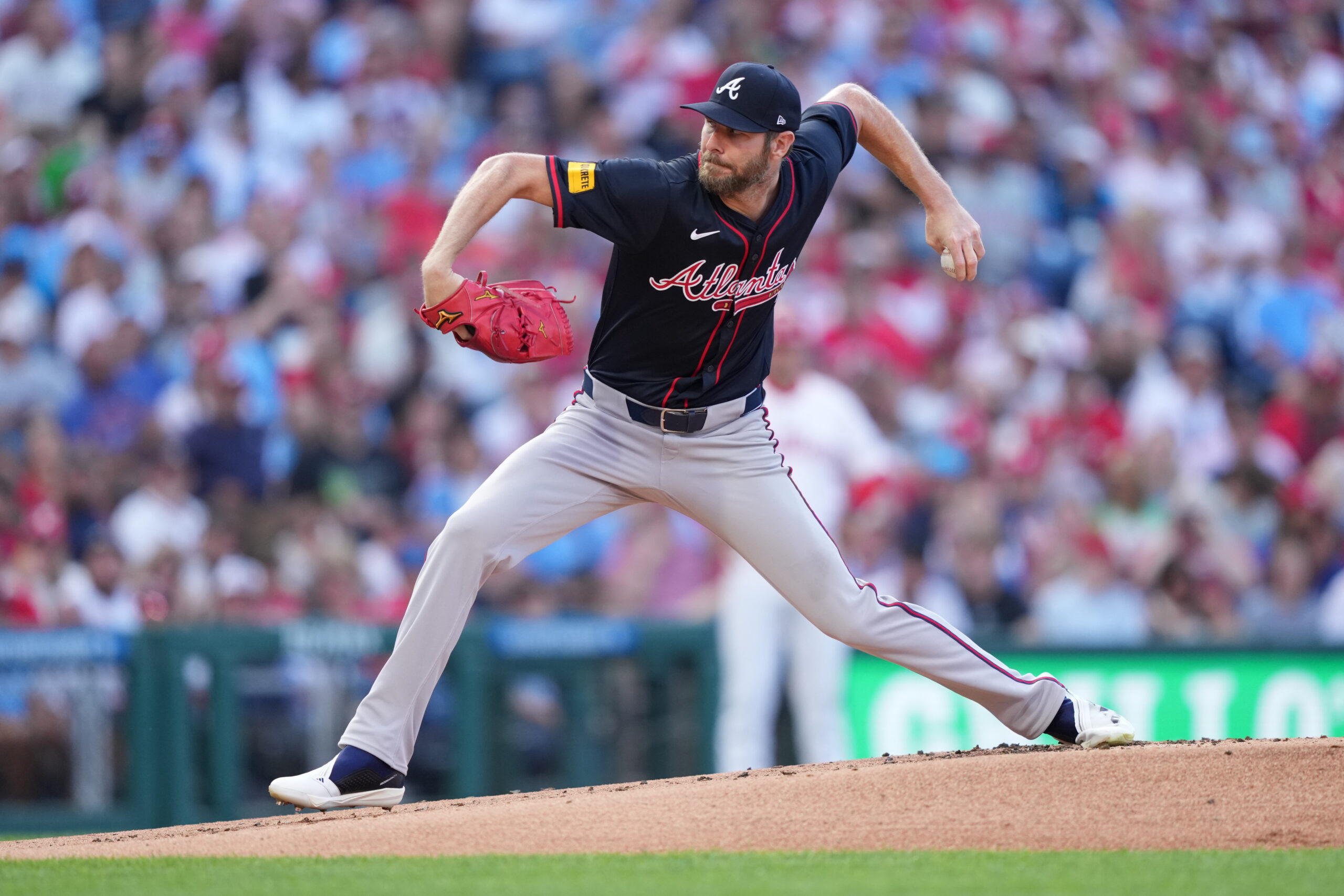
Chris Sale entered 2025 coming off his NL Cy Young campaign and carrying age-related questions into his age-36 season. The first few weeks did little to quiet those concerns, as he was tagged for a 6.17 ERA across his first five starts.
Once he settled in, however, Sale began to resemble the pitcher who dominated the previous year. Over his next 10 turns in the rotation, he allowed only nine earned runs combined, reestablishing himself as one of the most effective starters in the league before a ribcage fracture sidelined him for two months.
Sale returned in late August and delivered quality results down the stretch, wrapping up the year with a 2.58 ERA, 1.07 WHIP, and an excellent 165:32 strikeout-to-walk ratio (K/BB) across 125 2/3 innings. Those numbers closely mirror his Cy Young output when placed on a rate basis, which is noteworthy given both his early-season struggles and his age.
The skills remain intact: His fastball still misses bats, the slider continues to generate chases, and his command has held up enough to avoid free-pass issues.
Chris Sale in 2026 Fantasy Baseball: Strengths, Weaknesses, and Projections
From a points league perspective, Sale brings a premium blend of strikeouts, ratio protection, and efficiency. The strikeout-to-walk profile feeds directly into scoring systems that reward punchouts and penalize walks, while his ability to navigate lineups without implosion outings keeps his weekly scoring floor relatively stable when he is active.
The weakness, of course, is availability. Sale will turn 37 in March and has made more than 20 starts only once since 2019. He has not logged a 30-start season since 2017, so fantasy managers should anticipate at least some missed time in 2026.
The projection for 2026 centers on selective optimism. When on the mound, Sale still profiles as a legitimate top-of-the-rotation scorer in points formats. He can miss bats at a high rate, limit baserunners, and work deep enough into outings to accumulate strikeouts without wasting pitches.
The risk is tied entirely to workload. He is unlikely to provide 180 innings, but even 130 to 150 high-quality frames would make him valuable in leagues that reward strikeout volume and rate stats. Drafting him alongside a stable innings source is the natural hedge for managers looking to maximize value while guarding against injury gaps.
As far as pitcher hierarchy for fantasy baseball points leagues, I rank him at Tier 2 under Tarik Skubal, Garrett Crochet, and Paul Skenes, among others, and higher than Hunter Brown, Hunter Greene, and Bryan Woo.
Leave a Reply