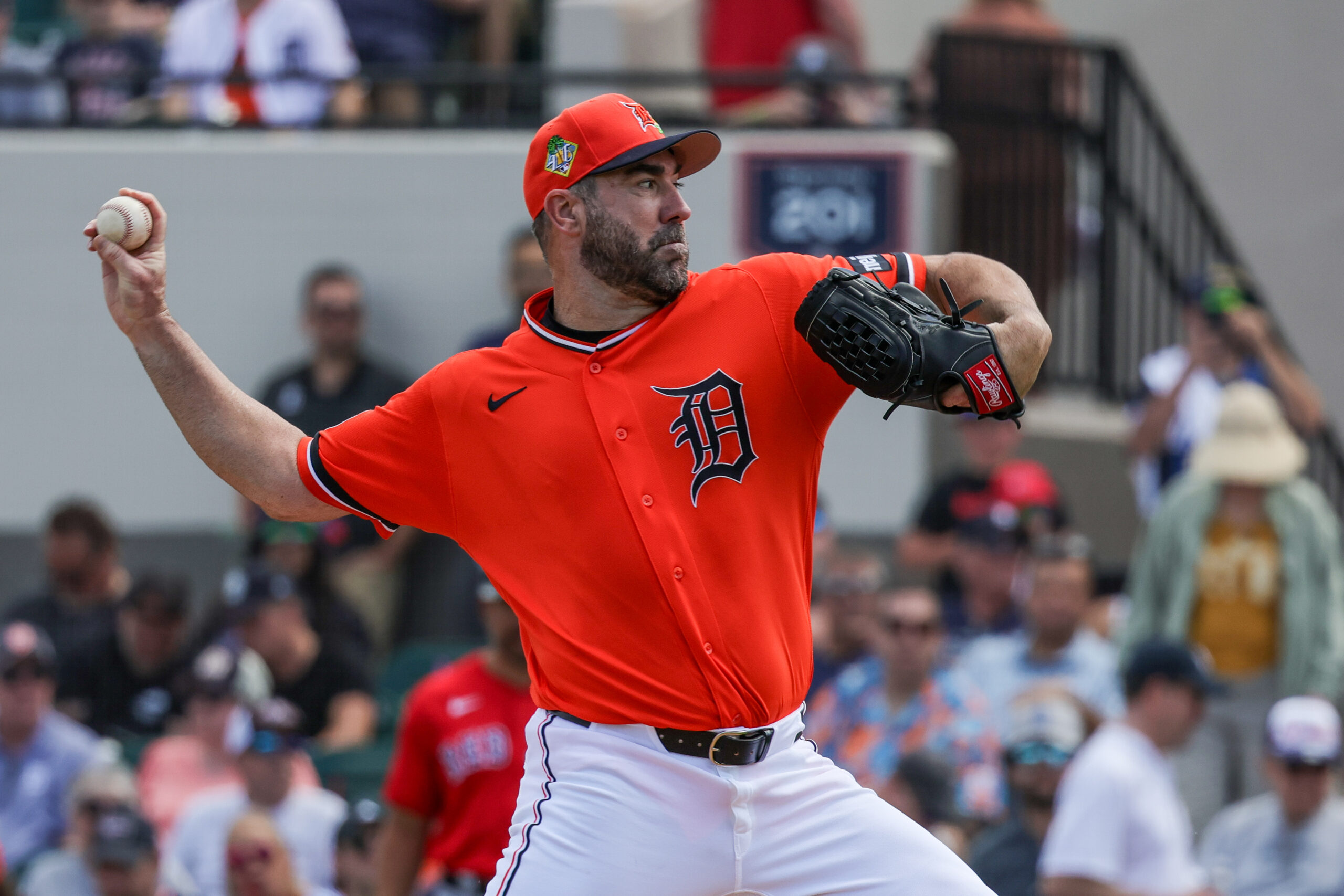
Justin Verlander’s late-season turnaround in 2025 created the appearance of a dramatic rebound, but a deeper look suggests the improvement was not as significant as the surface numbers indicated. He carried a 4.70 ERA across 76 2/3 innings before the All-Star break and followed it with a 2.99 ERA over 75 1/3 innings afterward, yet his expected fielding independent pitching remained nearly identical in both halves.
The veteran did raise his strikeout rate and surrendered fewer home runs down the stretch, though the largest factor behind the improved ERA was a notable increase in his left-on-base rate rather than a wholesale change in underlying performance.
Verlander still brings a Hall of Fame résumé and has posted a sub-4.00 ERA in two of the past three seasons, traits that naturally attract fantasy attention. However, the warning signs are becoming more difficult to ignore. His best xFIP since 2023 sits at 4.56 and has climbed as high as 5.13, reinforcing the idea that run prevention could become more volatile moving forward.
The veteran right-hander agreed to a one-year, $13 million contract with the Tigers after spending the 2025 campaign in San Francisco, where he logged a 3.85 ERA, 1.36 WHIP, and a 137:52 strikeout-to-walk ratio (K/BB) across 152 innings.
Verlander now returns to Detroit, the organization where he captured Rookie of the Year honors, an MVP award, and a Cy Young Award during the first 13 seasons of his major league career. He will be 43 years old when the 2026 season begins and is expected to help stabilize a rotation led by Tarik Skubal and Framber Valdez.
Justin Verlander’s Strengths, Weaknesses, and 2026 Fantasy Baseball Projection
Verlander’s strengths remain rooted in experience, pitchability, and an ability to adjust sequencing when his raw stuff is not overpowering. Even at this stage of his career, he has shown he can generate strikeouts in key moments and navigate lineups multiple times when his command is sharp. His durability in 2025, highlighted by 152 innings, also provided reassurance after earlier career interruptions.
The weaknesses, however, are tied directly to age-related decline. His margin for error is thinner, advanced metrics suggest regression risk, and extended outings can become challenging when hitters force deeper counts. Fantasy managers should also recognize that improved results tied heavily to strand rate are rarely dependable year over year.
From a fantasy baseball points league perspective, Verlander profiles more as a matchup-based starter than a weekly lock. He can still provide value in stretches, particularly against weaker offenses, but expecting ace-level production is unrealistic. A reasonable projection for 2026 includes an ERA in the upper-3.00s to low-4.00s with moderate strikeout totals and innings that help stabilize the back end of a fantasy rotation rather than anchor it.
As far as pitcher hierarchy for fantasy baseball points leagues, I rank him at Tier 13 under Tarik Skubal, Garrett Crochet, and Paul Skenes, among others, and higher than Colin Rea, Corbin Burnes, and Braxton Garrett.
Leave a Reply