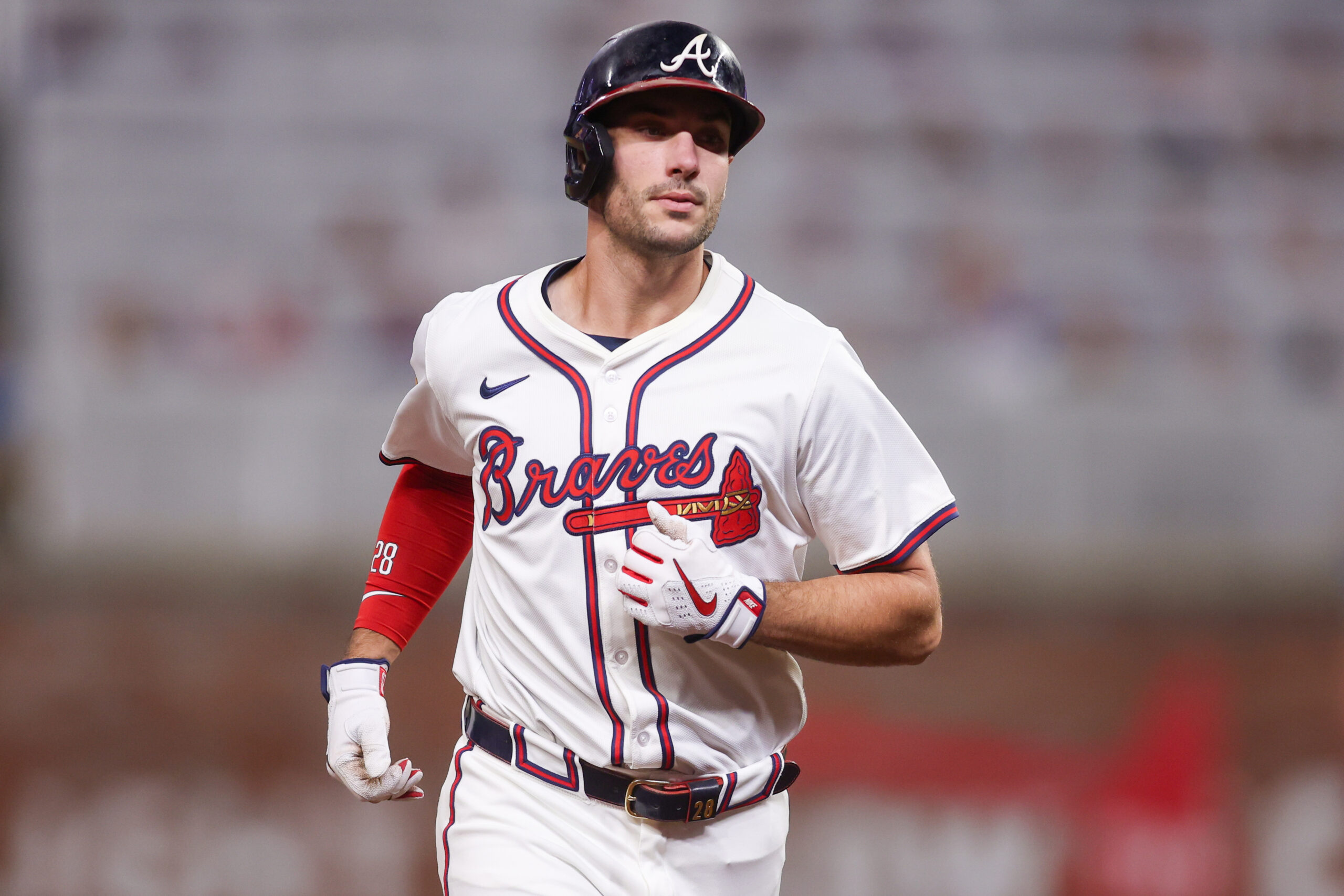
Matt Olson has been one of the most dependable everyday players in baseball, appearing in all 162 games in each of his four seasons with Atlanta. Since arriving in the National League, he has averaged 36.5 home runs and 108.8 RBIs per year, providing the Braves with consistent middle-of-the-order production even during stretches when Ronald Acuña Jr. and Austin Riley were sidelined and when Ozzie Albies and Michael Harris experienced performance swings.
Replacing Freddie Freeman in Atlanta came with enormous expectations, but Olson has comfortably delivered on that responsibility. He has earned two All-Star selections during his Braves tenure and added a third career Gold Glove in 2025, reinforcing his value on both sides of the ball. His combination of durability and power continues to make him one of the steadiest first base options available in fantasy formats.
Strengths, Weaknesses, and 2026 Projections for Matt Olson
Olson’s primary strengths remain his elite left-handed power, lineup stability, and outstanding availability. Few hitters offer his combination of home run consistency and everyday volume, which is especially valuable in fantasy baseball points leagues where plate appearances drive scoring.
His strikeout rate has stabilized around 25%, an acceptable trade-off given his power output, and he continues to support his on-base percentage with a walk rate that has reached double digits for six consecutive seasons.
The main limitations in Olson’s profile stem from the natural volatility of power-heavy hitters and the absence of meaningful speed contributions. When the power runs cold, his overall fantasy output can dip for stretches, and he does not provide category diversity beyond run production and on-base skills.
Even so, the durability floor and middle-of-the-order role significantly reduce week-to-week risk compared to most sluggers. From a fantasy baseball points league perspective, Olson projects to remain a high-end, volume-driven first baseman in 2026.
A realistic expectation includes another season in the mid-30s home run range with strong RBI totals, steady on-base production, and elite game-to-game availability that keeps his weekly floor intact. Olson’s consistent durability and middle-of-the-order role continue to make him especially valuable in points formats, where steady plate appearances and run production often separate elite fantasy contributors from more volatile power hitters across a full season.
As far as first base hierarchy for fantasy baseball points leagues, I rank him in Tier 2 under Vladimir Guerrero Jr., Nick Kurtz, and Pete Alonso, among others, and higher than Freddie Freeman, Rafael Devers, and Josh Naylor.
Leave a Reply