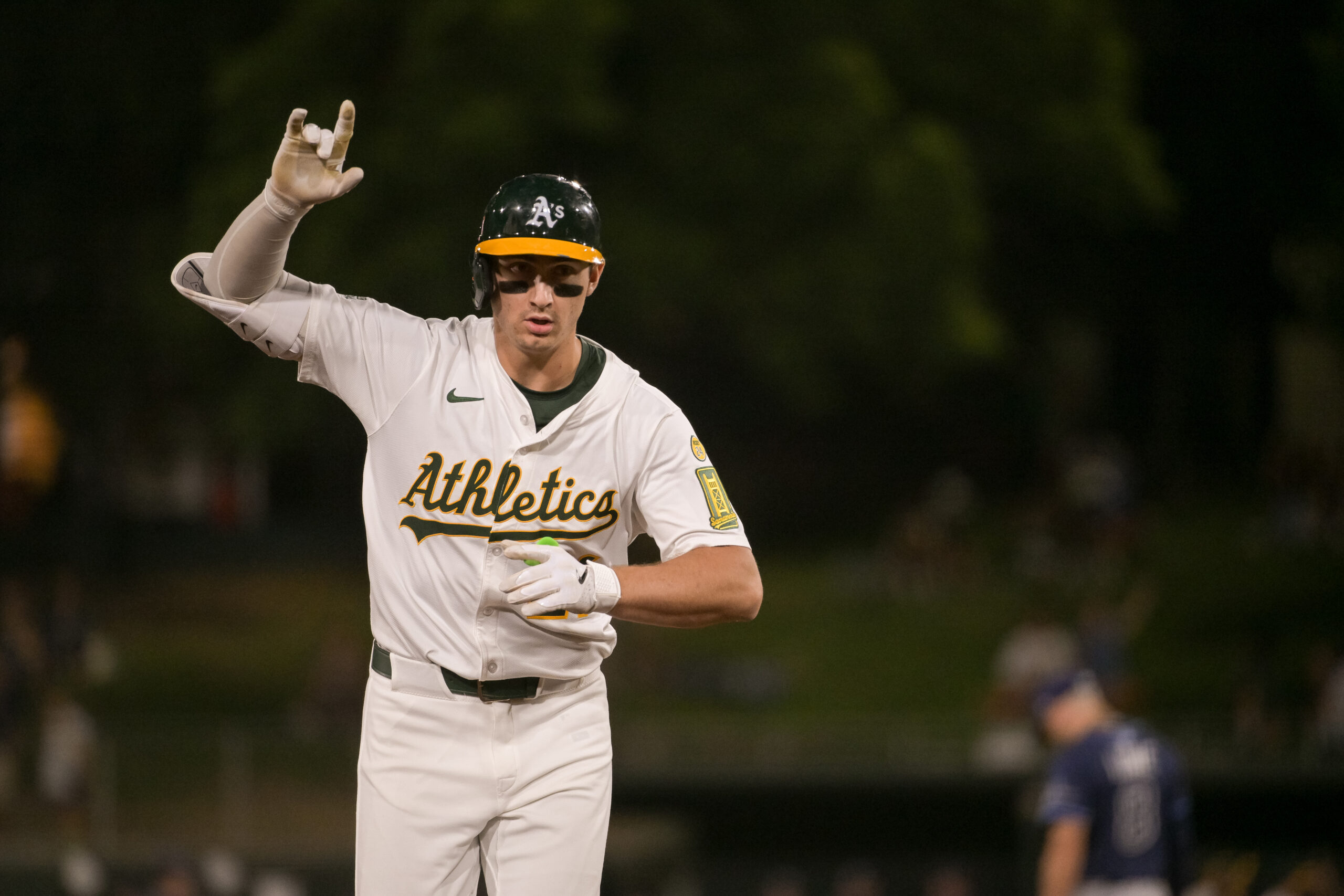
Tyler Soderstrom continued his defensive nomad tour in 2025, logging most of his time in left field after primarily playing first base in 2024. Despite the shift, he will retain first-base eligibility for 2026 thanks to his 49 appearances at the position. The positional flexibility adds a layer of quiet value for fantasy managers evaluating his profile.
At the plate, the young slugger delivered a significant step forward. Soderstrom produced 25 home runs, 93 RBIs, 75 runs, and a .276/.346/.474 slash line across 158 games, establishing himself as a legitimate middle-of-the-order contributor for the Athletics. He also chipped in eight stolen bases, a notable development considering he entered the season with just four steals across 407 professional games.
Tyler Soderstrom’s Strengths, Weaknesses, and 2026 Fantasy Baseball Projection
Soderstrom’s biggest strength in fantasy baseball points leagues is the combination of improving contact skills and stable power output. His strikeout rate (K%) dropped to 22.6%, a strong indicator that he may be putting earlier contact concerns behind him.
The improved 20.1% line-drive rate (LD%), paired with a reduced 31.8% fly-ball rate (FB%), supports the idea that his 2025 production was driven by meaningful skill growth rather than pure variance.
The primary concern is whether the power ceiling fully matches the optimism generated by his breakout. His batted-ball profile remained largely unchanged from 2024, which suggests there may not be another major power spike coming without further underlying gains. Additionally, the stolen base contribution is likely to remain modest, limiting his category diversity compared to elite options at the position.
Entering 2026, Soderstrom profiles as a steady power bat with improving plate skills and everyday playing time. In fantasy baseball points league formats, he projects as a solid mid-tier first baseman capable of delivering mid-20s home runs, strong RBI totals, and a helpful batting average, with incremental growth still possible if his contact gains fully stick.
Fantasy managers should still account for some volatility, particularly if his batted-ball distribution shifts or pitchers begin to challenge him differently. Even so, the combination of age, role security, and recent skill growth makes him an appealing upside target who could outperform his draft slot if the adjustments hold over a full season.
As far as first-base hierarchy for fantasy baseball points leagues, I rank him at Tier 4 under Vladimir Guerrero Jr., Nick Kurtz, and Pete Alonso, among others, and higher than Michael Busch, Yandy Díaz, and Salvador Perez.
Leave a Reply