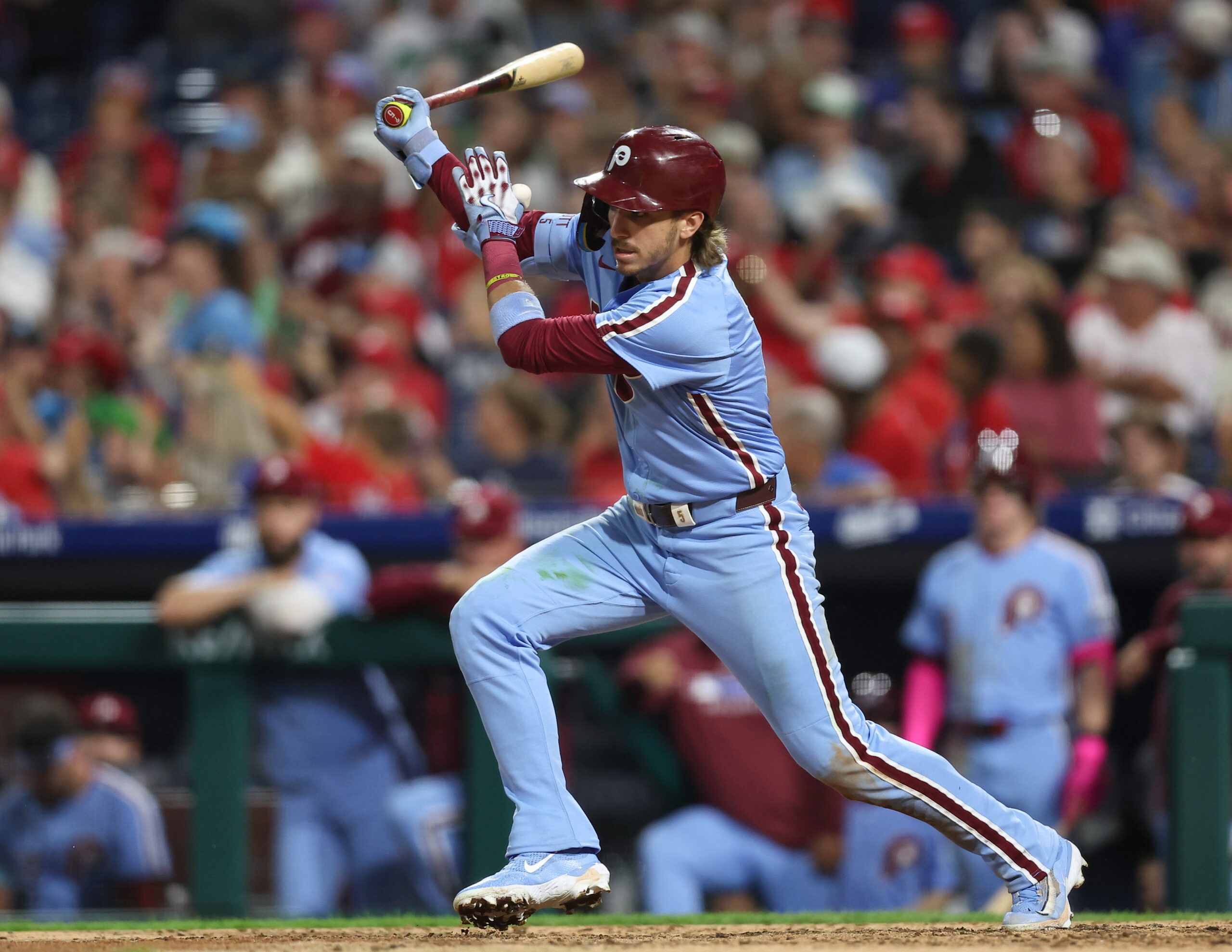
Bryson Stott remains a dependable everyday second baseman whose defensive value keeps him firmly in the Philadelphia Phillies’ plans, though his fantasy impact continues to be modest. He finished last season with a .257/.328/.391 slash line, closely mirroring his career .256/.318/.383 profile. His counting stats followed the same pattern of consistency, as Stott produced 13 home runs and 24 stolen bases, nearly identical to his career averages of 12.3 home runs and 24.8 steals.
The offensive ceiling remains well defined. While there is some upside if his stolen base total climbs back above the 30 mark he reached in both 2023 and 2024, meaningful growth with the bat appears unlikely.
Stott continues to make consistent contact, posting a 16.3% strikeout rate (K%) in each of the last two seasons, but the quality of that contact is limited. His 29.5% hard-hit rate last year ranked ninth-lowest among qualified hitters, which significantly restricts his power output and turns much of his contact into low-impact balls in play.
What to Expect from Bryson Stott in 2026 Fantasy Baseball
From a fantasy baseball points leagues perspective, Stott’s main appeal is stability. His speed provides a useful floor, and his ability to put the ball in play helps him avoid prolonged slumps that can damage weekly lineups. When he is playing regularly near the top half of the Phillies’ order, he can quietly accumulate runs and chip in across multiple categories, making him a serviceable middle-infield option in deeper formats.
The concerns center on both role security and offensive upside. Stott has frequently sat against left-handed pitching and owns a career .666 on-base plus slugging (OPS) in 529 plate appearances versus southpaws. With Edmundo Sosa available as a capable right-handed infield option, Philadelphia could continue deploying a partial platoon in 2026.
Any loss of plate appearances directly limits Stott’s ability to compile counting stats, which is the primary driver of his fantasy usefulness. Combined with his limited hard-contact profile, the path to a true breakout remains narrow.
Entering 2026, Stott projects as a steady but capped fantasy contributor whose value is driven more by speed and playing time than by impact hitting. A reasonable expectation includes low-teens home run production with 20 to 30 stolen bases and modest run totals if he maintains a regular role.
As far as second base hierarchy for fantasy baseball points leagues, I rank him at Tier 5 under Jazz Chisholm Jr., Ketel Marte, and Brice Turang, among others, and higher than Caleb Durbin, Otto López, and Matt McLain.
Leave a Reply