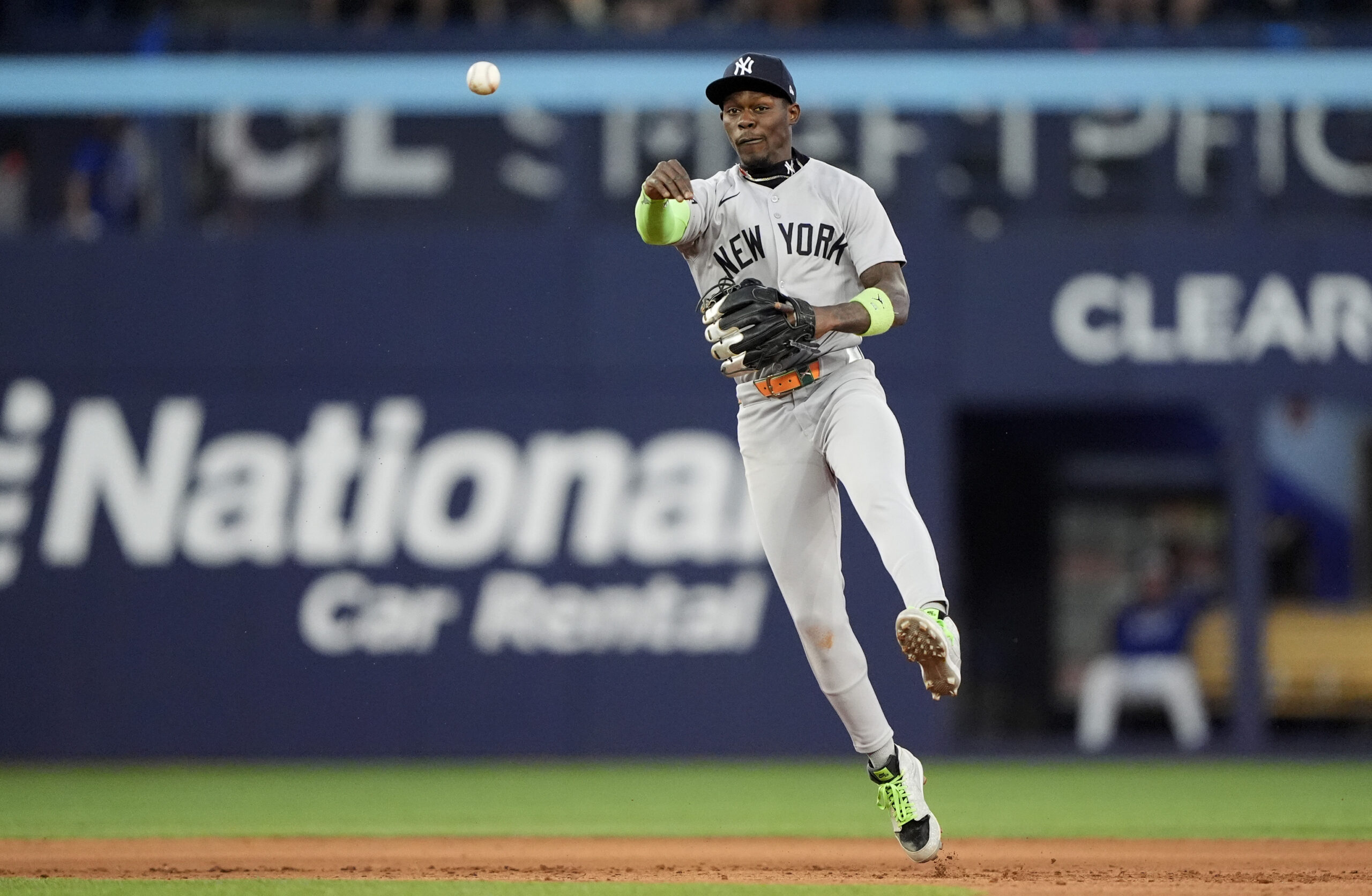
Second base in points leagues is driven by a blend of category volume, lineup role, and plate discipline stability. Unlike roto formats, where steals alone can elevate a player, points scoring rewards players who stay on the field, limit strikeouts, and contribute across multiple counting categories. The rankings below reflect expected 2026 impact with that lens in mind.
1. Jazz Chisholm Jr.
Jazz Chisholm enters his age-28 season coming off the most complete year of his career, launching 31 home runs and stealing 31 bases on the way to a Silver Slugger and his second All-Star nod.
The power-speed combination plays extremely well in points formats when he is locked in, especially hitting left-handed in Yankee Stadium. The risk remains the elevated career strikeout rate and prior injury history, which can create streaky production. Even with the volatility, his category impact and multi-position flexibility give him the highest ceiling at the position.
2. Ketel Marte
Ketel Marte continues to set the standard for well-rounded second-base production, leading qualified players at the position with a 145 weighted runs created plus (wRC+) in 2025. Despite missing time with a left hamstring issue and playing only 126 games, he still delivered 28 home runs with a strong slash line and career-best 11.5% walk rate (BB%).
His three-year run of strong batting averages and near-30 homer pace provides one of the safest offensive profiles at the keystone. Durability is the only mild concern as he enters his age-32 season, but the underlying production remains elite.
3. Brice Turang
Brice Turang evolved from a speed-first profile into a much more complete offensive contributor in 2025. He posted a .288/.359/.435 line with 18 home runs, 24 steals, 81 RBIs, and 97 runs across 156 games, showing major growth in quality of contact.
The swing changes that boosted his hard-hit rate and bat speed give credibility to the power jump, even if some regression is possible. With elite speed still in the profile and everyday volume secure, Turang offers a strong points foundation with room for further growth.
4. Nico Hoerner
Nico Hoerner remains a contact-driven table setter whose fantasy value is tied to batting average, steals, and run production. His .297 average in 2025 and 103 stolen bases over the past three seasons highlight the stability of his skill set.
While the lack of power caps his ultimate ceiling in points leagues, his ability to reach base and contribute across categories keeps him firmly inside the top tier of second basemen. His outlook would improve even further if he consistently holds a premium lineup spot.
5. Maikel Garcia
Maikel Garcia followed up a speed-heavy 2024 with a true offensive breakout in 2025, posting a .286/.351/.449 line with 16 home runs and 23 steals across 160 games. The improvement was backed by better plate discipline and stronger batted-ball metrics, suggesting real growth rather than pure luck.
If the contact gains hold and the stolen bases tick back toward previous levels, there is room for another step forward. Positional eligibility changes could slightly affect flexibility, but the bat plays.
6. Luke Keaschall
Luke Keaschall’s rookie campaign showed why the Twins were so excited about his offensive profile. He demonstrated strong plate discipline with low strikeout rates and quality contact skills while also flashing high-end speed on the bases.
Injuries interrupted what could have been a larger breakout, which keeps some risk baked into his projection. If he stays healthy and holds a top-of-the-order role, his on-base ability and speed give him intriguing points upside despite modest power.
7. Jose Altuve
Jose Altuve remains productive but is clearly moving into the later stage of his career. His 26 home runs and 10 steals in 2025 still provided usable fantasy production, yet the declining batting average and reduced speed point to a narrowing fantasy margin.
Defensive shifting between second base, left field, and designated hitter also reflects the natural aging curve. He should continue to provide steady counting stats in Houston’s lineup, but the days of elite across-the-board production appear to be fading.
8. Ceddanne Rafaela
Ceddanne Rafaela brings defensive excellence and useful power-speed flashes, but his points profile is limited by on-base concerns and inconsistent contact quality. He did produce his first 15–20 season in 2025, showing the raw tools to matter in fantasy.
However, his offensive value remains heavily volume-dependent, especially if he focuses primarily on center field in 2026. He is useful, but the weekly ceiling is more modest than the names above him.
9. Ozzie Albies
Ozzie Albies enters 2026 as one of the tougher players to project after back-to-back disappointing seasons. His power output fell sharply in 2025, and the underlying batted-ball data showed concerning declines across several quality-of-contact metrics.
While he is expected to be fully recovered from late-season hamate bone surgery in his left hand and is still in his physical prime, recent performance trends make a full bounce-back difficult to assume. The upside remains, but the risk profile has grown.
10. Brandon Lowe
Brandon Lowe heads into 2026 in a very different context after the Rays moved him to Pittsburgh, where he is expected to step in as the Pirates’ primary second baseman and provide much-needed power to the middle of the lineup.
Lowe remains a dangerous bat against right-handed pitching, and the move should keep his plate appearances steady in a lineup that needs his thump. The concern in points leagues is that the profile still carries volatility due to platoon risk and durability history, which can lead to uneven weekly returns. Lowe can still deliver useful power production, but the margin for error is thinner than it looks if the playing time or consistency wobbles.
Leave a Reply