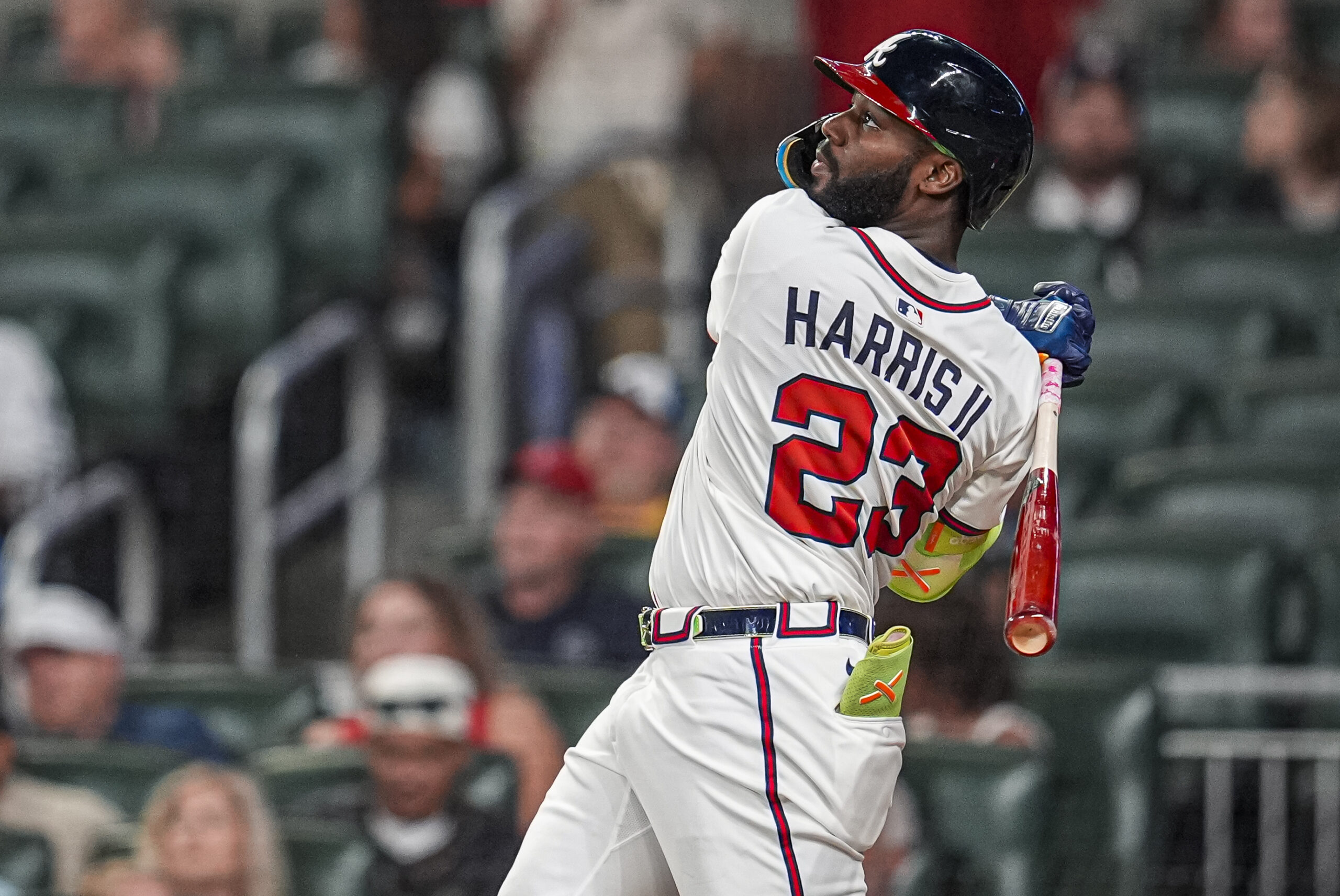
Michael Harris II entered last season as a top-40 draft selection, but his performance in the first half of the season fell well short of expectations. At the All-Star break, he was hitting just .210/.234/.317, and by mid-July he had been dropped in some leagues. The turnaround began after mechanical adjustments to his swing in July, leading to a dramatically improved second half.
Following the break, Harris slashed .299/.315/.530 with 14 home runs, 33 runs scored, and 42 RBIs over 67 games. In that span, he nearly matched or surpassed his production in all three run categories compared to the 93 games before the break. The transformation was significant and reminded fantasy managers of the upside that made him an early-round pick.
However, even during that hot stretch, his on-base plus slugging (OPS) remained modest relative to his batting average. Harris finished the season with one of the lowest walk rates and highest chase rates among qualified hitters.
His monthly OPS illustrates the volatility: .614, .608, .426, .850, .885, and .635. The peaks are impactful, but the valleys can be difficult to absorb in weekly formats.
Michael Harris II’s Fantasy Baseball Strengths, Weaknesses, and 2026 Projection
In fantasy baseball points leagues, Harris offers a compelling blend of athleticism and power-speed upside. His defensive value ensures consistent playing time, which supports counting-stat accumulation when his bat is locked in. Last season, the production in the second half demonstrates that he can provide middle-of-the-order impact with home run pop and run production when adjustments take hold.
The concern is approach-driven inconsistency. His low walk rate (BB%) limits his floor in points formats that reward on-base events, and his aggressive tendencies contribute to prolonged slumps. Because his production is closely tied to contact quality rather than plate discipline, he remains prone to streaky stretches that can swing fantasy matchups in either direction.
Entering 2026, Harris projects as a volatile but high-upside outfielder capable of producing 20 to 25 home runs with solid run and RBI totals if his adjustments in the second half of the season carry over. A modest improvement in walk rate would meaningfully stabilize his weekly output, but even without it, his tools keep him firmly on the fantasy radar.
As far as the outfielder hierarchy for fantasy baseball points leagues, I rank him at Tier 5 under Aaron Judge, Juan Soto, and Ronald Acuña Jr., among others, and higher than Oneil Cruz, Christian Yelich, and Jose Altuve.
Leave a Reply