Keeper formats reward long-term stability, age insulation and repeatable skill growth. Players who carry mounting durability concerns, role volatility or age-related risk often slide down boards compared to their redraft value. The following names remain useful fantasy contributors, but their keeper appeal is more fragile heading into 2026.
Keeper Fantasy Baseball: The Sell Now List
Ronald Acuña Jr.
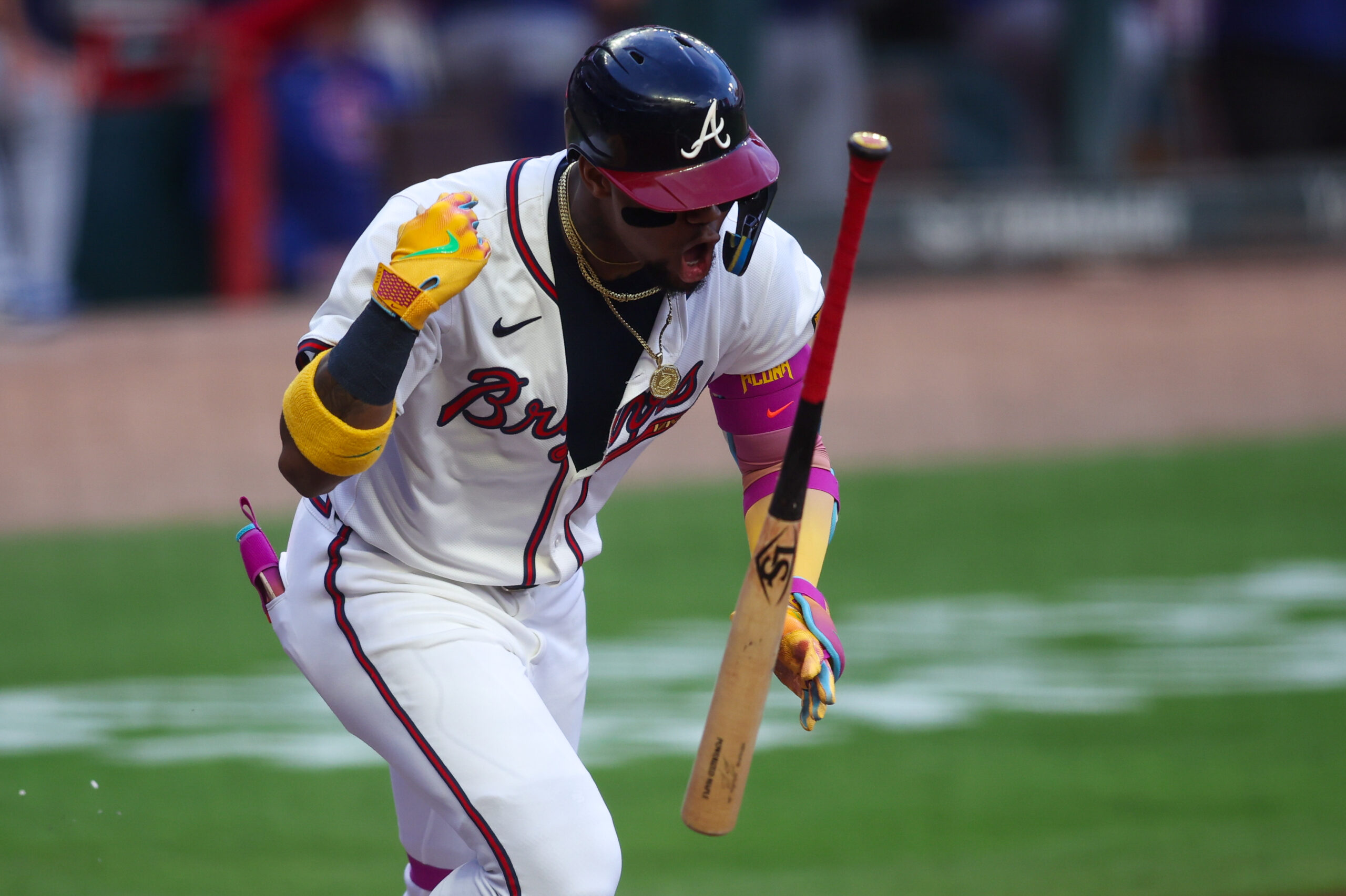
Ronald Acuña Jr. still offers elite-category upside, but keeper managers have to weigh availability risk more carefully now. He appeared in only 95 games in 2025 while returning from left ACL rehab and later dealing with a right calf issue, and he has reached 100 games just twice in the past five seasons.
The .290/.417/.518 line with 21 home runs shows the bat remains dangerous, yet the drop to nine steals after the 73-steal explosion in 2023 highlights how health directly affects his fantasy ceiling. Entering his age-28 season, he can still deliver top-tier production, but the injury pattern introduces more long-term volatility than keeper investors typically prefer at his cost.
Jacob deGrom
Jacob deGrom’s 2025 rebound proved he can still dominate lineups, logging 172 2/3 innings with a 2.97 ERA and 0.92 WHIP, but the keeper profile is much riskier than the surface numbers suggest. His Strikeout Rate (K%) dipped to 27.7 percent, down from a 30.6 percent career mark, and his velocity remains a few ticks below peak levels following Tommy John surgery.
More importantly, he turns 38 this summer and failed to reach 100 innings in every season between 2020 and 2024. Even after a strong year, long-term durability and age trends make him far less attractive in keeper builds than in win-now formats.
Yordan Alvarez
Yordan Alvarez’s bat still shows elite plate discipline, evidenced by a 14.5 percent Walk Rate (BB%) and 16.6 percent Strikeout Rate (K%) in 2025, but durability is becoming a real keeper concern. He was limited to just 48 games by a right hand fracture and left ankle sprain and posted a career-worst .797 On-base Plus Slugging (OPS) with only six home runs.
At age 28, the underlying skills remain strong enough for a rebound, yet recurring missed time is more damaging in keeper formats where multi-year stability is critical. The upside remains high, but the long-term risk profile is no longer clean.
Mookie Betts
Mookie Betts continues to produce useful counting stats in the Dodgers lineup, but the overall trend line is flattening. His .258/.326/.406 slash with 20 home runs and eight steals in 2025 marked his least productive full season, and the drop in hard-hit rate to a career-low 35.8 percent raises mild concern about the power ceiling.
Now entering his age-33 season with single-position eligibility, Betts still offers a solid floor but less long-term upside than earlier in his career. Keeper managers typically prioritize players whose peak production windows are still expanding, not stabilizing.
Brice Turang
Brice Turang’s breakout season was impressive on the surface, but keeper leagues require confidence that the gains will hold. He slashed .288/.359/.435 with 18 home runs and 24 steals in 2025, yet a significant portion of the power spike came during a scorching August in which he hit 10 home runs.
His Strikeout Rate (K%) also jumped to 22.8 percent as he swung more aggressively. The improved hard-hit profile is encouraging, but the profile still leans heavily on speed and batting average sustainability. If the power settles back closer to previous levels, his long-term ceiling becomes more modest than his recent numbers suggest.
Corey Seager
Corey Seager remains a premium hitter when healthy, but his keeper value is complicated by durability interruptions and volatile year-to-year outcomes. An appendectomy shortened his 2025 season, ending a three-year run of 30-plus home runs, and his production has shown wide batting-average swings over the past four seasons.
The power should rebound in a full year, yet keeper managers must account for both health interruptions and lineup-dependent run production. That combination introduces more long-range uncertainty than typically desired at his draft cost.
Aroldis Chapman
Aroldis Chapman was outstanding in 2025 with a 1.17 ERA, 0.70 WHIP and 32 saves, but keeper leagues are forward-looking, and he enters his age-38 season. Even with improved control and elite strikeout production, relievers in this age range carry inherent role and performance volatility.
Boston’s extension signals short-term trust, but the long-term shelf life of late-30s closers is historically fragile. In single-season formats he remains useful, yet keeper managers often avoid investing heavily in aging relievers.
Devin Williams
Devin Williams’ underlying metrics remain strong, including a 25.1 percent Strikeout-to-walk Ratio (K/BB) and a large ERA-FIP gap that hints at better days ahead, but his role security has already shown cracks. He lost the closing job early in 2025, briefly regained it, then lost it again after the Yankees acquired David Bednar.
Now with the Mets on a three-year deal, he currently projects as the closer but without absolute certainty, as the Mets also signed Williams’ former Yankees teammate Luke Weaver as insurance at closer. Keeper formats penalize bullpen volatility heavily, and any future role turbulence would quickly erode his long-term value.
George Springer
George Springer’s 2025 resurgence was impressive, as he delivered 32 home runs, 18 steals and a .309 average with strong quality-of-contact metrics. The concern in keeper leagues is simple: he enters his age-36 season.
Even with increased designated hitter usage helping preserve his workload, age-related decline can arrive quickly for players in this range. The skills may hold for another year or two, but keeper managers typically prefer investing in hitters whose prime window is still open rather than potentially closing.
Ozzie Albies
Ozzie Albies profiles as a bounce-back candidate after a difficult 2025, but keeper investors must weigh the longer trend. He finished with a .671 On-base Plus Slugging (OPS) and 87 Weighted Runs Created Plus (wRC+) while hitting only 16 home runs across 667 plate appearances before a fractured hamate bone in his left hand ended his season.
His hard-hit rate, barrel rate and exit velocity all fell to three-year lows, and he has disappointed in three of the past four seasons. At age 29 he is not necessarily in decline, yet the recent performance erosion makes his long-term projection less stable than his name value suggests.
These players can still help win leagues in 2026, but in keeper formats where multi-year outlook matters, each carries enough structural risk to warrant a more cautious investment approach.
Leave a Reply