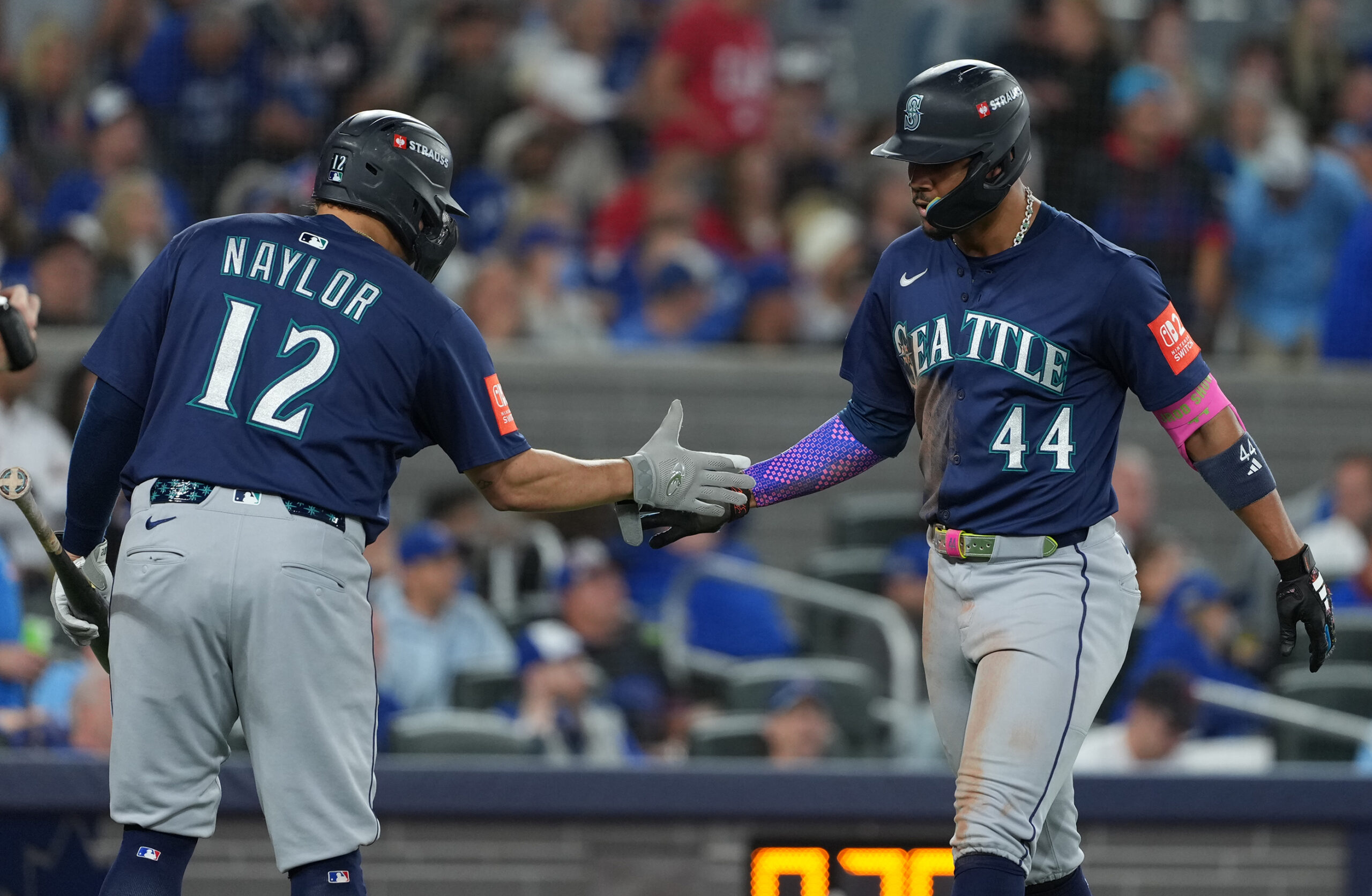
The AL West is changing. After winning four straight division titles and seven of eight, Houston finally slipped in 2025 and surrendered the division to Seattle.
The Mariners had long owned the pitching to win this group, and a monster season from Cal Raleigh helped the offense finally catch up. Seattle came within one win of reaching the World Series for the first time in franchise history.
At the moment, this is Seattle’s division to lose. Houston reworked the roster but did not clearly improve.
Texas tried to fix its offense and still has enough pitching to stay interesting. The Athletics are moving in the right direction, but their staff remains a problem, while MLB predictions reflect that the Angels still look far from contention.
What to Expect from the Seattle Mariners in 2026
Seattle spent most of 2025 hovering just above .500, but a 17-8 September surge pushed the club past Houston and into first place in the AL West. The Mariners carried that momentum into October, beat Detroit in the ALDS, and then nearly reached the World Series before George Springer ended their run with a crushing three-run homer in the ALCS. It was the closest Seattle had come to winning the pennant.
Cal Raleigh had one of the greatest seasons ever by a catcher, blasting 60 home runs while driving in 125 and scoring 110 times. Julio Rodríguez recovered from another slow start to produce a 30-30 season, Randy Arozarena played well, and Josh Naylor gave the lineup a boost after the trade deadline. The staff was a little less dominant than expected overall, but Bryan Woo and Andrés Muñoz stood out.
The Mariners were measured but effective. Naylor was retained on a five-year deal, Harry Ford was traded to Washington for reliever Jose A. Ferrer, and Brendan Donovan was acquired in a three-team deal to help at third base and second base. It was not a flashy winter, but it was one that made sense for a roster already close to the top.
Seattle has the roster to reach the World Series. Raleigh is now one of the most valuable players in baseball at any position, Rodríguez remains capable of another leap, and the supporting cast around them is good enough to be dangerous. Colt Emerson could eventually give the offense another needed lift if he arrives quickly.
The rotation is still the real separator. Bryan Woo, Logan Gilbert, Luis Castillo, and George Kirby can match up with any staff, and Bryce Miller is a strong candidate to rebound. Muñoz is one of the better closers in the league, and the bullpen is deep enough behind him.
The most plausible way this goes sideways is through the lineup. Raleigh should still be excellent, but repeating a 60-homer season is a massive ask, and the bottom of the order still does not look like that of a complete contender.
If Emerson is not ready and no secondary bat emerges, Seattle could again find itself overly dependent on pitching. Even last year, with Raleigh having a historic season, the Mariners were only a fringe playoff team entering September.
Seattle appears to have the strongest roster in the division and should not need another miracle month to win it. If the pitching staff stays relatively healthy, the Mariners have a very real shot to finish with one of the best records in the American League and make another deep postseason run.
How the Houston Astros Can Reclaim the AL West
Houston’s run of postseason trips finally ended. The Astros led the AL West by seven games at the beginning of July, then posted sub-.500 records in each of the final three months and lost the final Wild Card spot on a tiebreaker. The offense dropped from 11th in runs scored in 2024 to 21st in 2025, while the pitching staff also regressed.
There were still some positives. Hunter Brown developed into an ace, Josh Hader was excellent before a shoulder injury ended his season in August, and Jeremy Peña took an important step forward offensively. But Yordan Alvarez was limited to 48 games and far less productive than usual, and Christian Walker was a major disappointment.
Houston made several moves, but none clearly changed the team’s trajectory. Mauricio Dubón was dealt for Nick Allen, Mike Burrows was acquired to help cover the loss of Framber Valdez, Tatsuya Imai chose Houston from Japan, and Ryan Weiss arrived after two seasons in the KBO.
The Astros also reacquired Joey Loperfido. The offseason ended on another negative note when Hader reported biceps inflammation and fell behind schedule.
There is still enough veteran talent here for one more strong season. If Alvarez gives the lineup something close to 140 games and a .900 OPS, everything changes.
Jose Altuve, Carlos Correa, and Walker are all older, but each still has a path to useful production, and Peña has grown into a strong lineup piece. If Imai adapts quickly and Hader is healthy, Houston could field a capable enough staff to hang around the race.
This could unravel quickly. Walker already looked past his peak last year, and Altuve and Correa have both shown signs of decline. Peña’s health also became a concern after a broken finger interrupted his WBC plans.
The rotation behind Brown has very little established reliability, and the bullpen becomes shaky immediately if Hader is not right. If the veterans age all at once, Houston could spend more time battling Texas and the Athletics than Seattle.
This feels like the year the dynasty fully gives way. Houston still has enough talent to remain competitive, but the roster now requires too many things to break right. The Astros could hover around relevance for much of the year, but they no longer look like a favorite to win the division or grab a Wild Card spot.
Can the Texas Rangers Bounce Back in 2026?
Texas wasted a tremendous year on the mound. The rotation led the majors with a 3.47 ERA thanks to excellent seasons from Jacob deGrom and Nathan Eovaldi, along with strong work from Jack Leiter and Patrick Corbin. The bullpen also held together better than expected despite lacking a defined closer.
The problem was the offense, which ranked only 22nd in runs scored. Corey Seager missed 60 games, Marcus Semien and Adolis García declined badly, and Joc Pederson and Jake Burger failed to deliver in their first seasons with the club.
The Rangers made several notable changes. Jonah Heim and García were non-tendered, Danny Jansen was signed to pair with Kyle Higashioka, Brandon Nimmo was acquired for Semien in a one-for-one deal that may work out well for Texas, and MacKenzie Gore was added from Washington in a major January trade.
Texas still has a playoff path if the pitching stays strong and the offense rebounds. DeGrom needs to stay healthy, Eovaldi must remain effective, and Gore has to rediscover the form he showed early last season. Leiter is still young enough to improve further, and Kumar Rocker still has considerable upside.
At the plate, the Rangers need better years from Pederson, Burger, Evan Carter, and Josh Jung, along with a healthy season from Seager and another step from Wyatt Langford. If several of those things happen at once, Texas can absolutely stay in the division race.
There is too much uncertainty to fully trust this group. DeGrom and Eovaldi are both age and health risks, and the bullpen likely will not be able to repeat its overachievement from last year.
Offensively, it is also unrealistic to expect nearly every disappointing hitter to bounce back. A more likely outcome is a respectable lineup paired with a pitching staff that takes a modest step backward.
Texas looks like a team that should remain in the race into late September without quite being complete enough to get over the line. Seattle still has the better overall roster, and the Wild Card competition will be intense. The Rangers should be competitive but slightly short.
What to Watch from the Athletics in 2026
The Athletics finally gave their fan base some reason for optimism. After years of rebuilding and relocation uncertainty, the club won 76 games, its highest total since 2021, and improved significantly over the second half.
The offense finished 12th in runs scored, with Nick Kurtz and Jacob Wilson immediately transforming the lineup as rookies. Kurtz posted a 1.002 OPS and won AL Rookie of the Year, while Wilson hit .311. Brent Rooker remained productive, Tyler Soderstrom improved, and Shea Langeliers was one of baseball’s best hitters in the second half.
The Athletics were relatively quiet, which made sense for a club still in transition. Their one notable move was trading for Jeff McNeil, who should benefit from the more hitter-friendly environment and help stabilize second base. Otherwise, the roster remained mostly intact.
This offense is capable of becoming one of the most entertaining in baseball. Kurtz and Wilson should both get fuller workloads, Langeliers may continue his surge, and Lawrence Butler still has breakout potential. If the lineup clicks, the Athletics could hang around the periphery of contention into September.
For that to matter, though, the rotation would need competent work from Luis Severino, Jeffrey Springs, Jacob Lopez, and Luis Morales.
The pitching remains the obvious problem. The A’s finished 27th in ERA last season, and there is little reason to expect a dramatic improvement.
Severino is openly unhappy with his situation, Springs and Lopez are the only starters who showed more than flashes last year, and the bullpen lacks proven talent. There are pitching prospects coming, but none profiles as an immediate game-changer.
The Athletics should be one of the more fun non-contenders in baseball. The lineup is real and will create plenty of noise, but the pitching staff still looks too weak for a genuine playoff push. A finish near third place in the division would still count as useful progress.
Los Angeles Angels 2026 Outlook: Stuck in a Rebuild
The Angels stayed trapped in the same cycle. They finished last in the AL West again, extending their streak of losing seasons to 10. A bad start and ugly finish doomed them, even though they were only two games under .500 on July 30.
The offense had real power, finishing fourth in home runs behind big seasons from Jo Adell, Taylor Ward, Mike Trout, and Zach Neto. But the pitching staff ranked 28th in ERA and gave the lineup little chance to matter. Injuries were not even the main excuse, as several starters were available enough but simply ineffective.
The Angels made several moves, but as usual, it is difficult to say whether they are actually better. Taylor Ward was traded to Baltimore for Grayson Rodriguez, who missed all of 2025 with an elbow injury. Vaughn Grissom was added from Boston, Josh Lowe arrived from Tampa Bay to replace Ward, Kirby Yates was signed to help the bullpen, and Yoan Moncada returned after a decent 2025 in Anaheim.
The path to competitiveness is narrow, but it exists. Josh Lowe would need to bounce back, Grissom would have to hit enough to help, and Trout would need one more significant run as an impact bat.
Adell and Neto are moving in the right direction, and Logan O’Hoppe is better than his numbers from last season. On the mound, Rodriguez would need to return to form, while Yates, Robert Stephenson, and Drew Pomeranz could stabilize the late innings.
This could get ugly fast. If Lowe does not rebound, the lineup will clearly miss Ward, and the lower half of the order already looks weak. If Rodriguez is not healthy or effective, the rotation has almost no path to even mediocrity.
The bullpen is also heavily dependent on aging or injury-prone arms. There is a very real chance the Angels finish with the worst ERA in the American League.
This should be the year the Angels finally accept the need for a full rebuild. There are still some younger pieces worth keeping around, but the larger roster structure is not working.
If the club gets off to another slow start, the smartest move would be to sell aggressively and begin building toward something more sustainable. The current path has gone nowhere for too long.
Leave a Reply