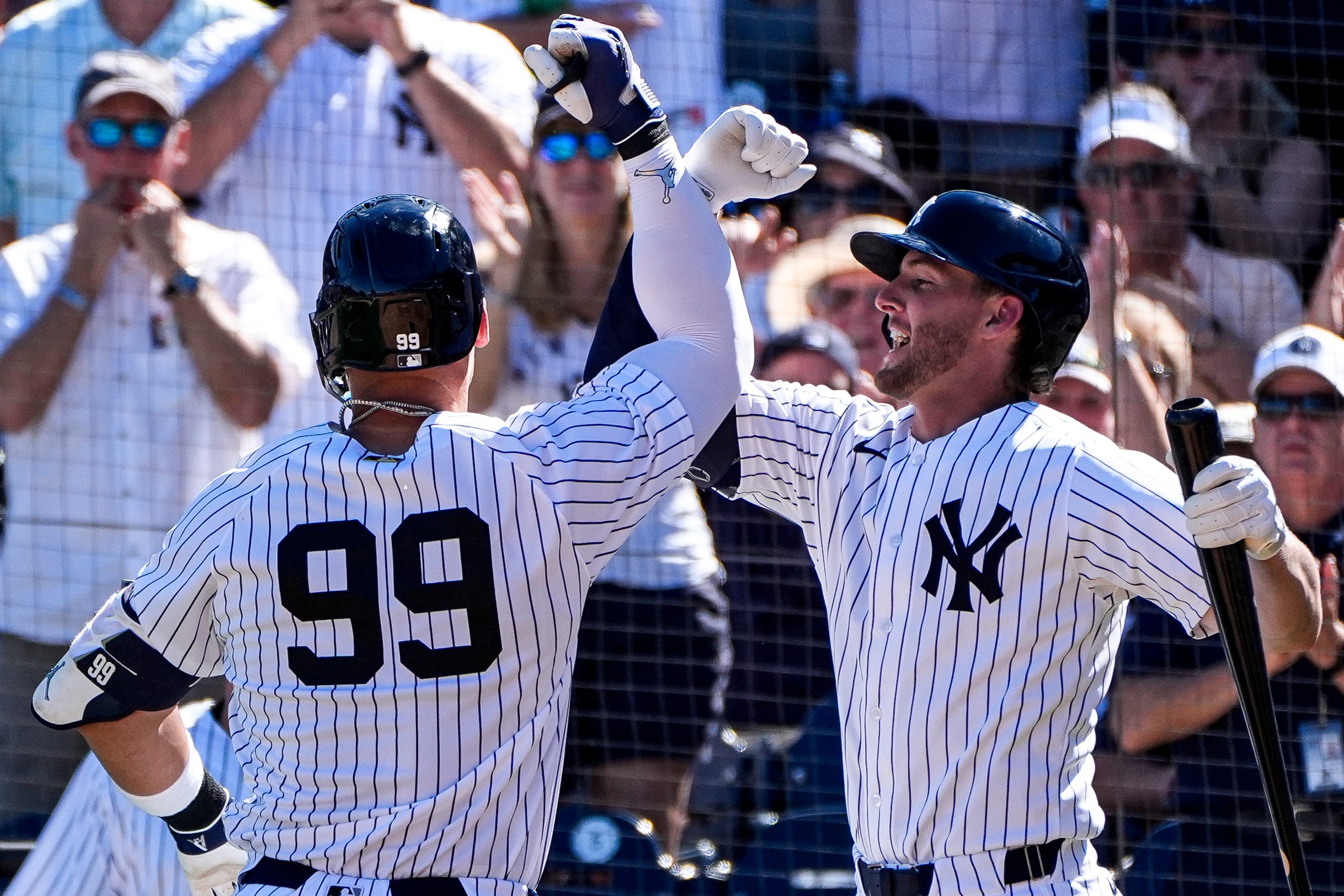
If you haven’t played Daily Fantasy Baseball and you’re interested in trying it, we have built a comprehensive guide so you have all the nuances of this game in one place. From learning how to build a lineup to analyzing the best strategies, you can find everything you need to know about DFS baseball.
DFS is extremely popular not only in the United States but in the entire world. Baseball has a whole world of possibilities in terms of how to approach DFS slates because it has double-digit games nearly every day from the beginning of the season in late March all the way to late September.
If you’re new to fantasy baseball, this guide will show you how to navigate the complex space of baseball DFS.
How to Assemble a DFS Baseball Lineup
After you’ve entered a contest in the platform of your choice, the first thing you need to do is assemble a lineup. Typically, DFS lineups in baseball consist of one or two pitchers, a catcher, a first baseman, a second baseman, a shortstop, a third baseman, three outfielders, and a utility player, which can be any hitter of your choice.
It’s important to know that every player has a specific value. Each contest, regardless of the platform you choose, has a salary cap and roster rules you should follow. Salaries are assigned to players based on their performance, matchup, and expected production. Several factors come into play when analyzing a player’s value.
The goal is simple. You have to assemble the highest-scoring lineup in your slate without exceeding the limit of your salary. That’s when the strategy becomes important because you need to understand your roster construction in order to draft the best possible lineup.
How Players Score Points in DFS Baseball
Just like in regular season-long fantasy formats, players earn fantasy points based on their real-life performance. Hitters earn their points in five different categories, which are:
- Hits
- Home Runs
- RBI
- Runs Scored
- Stolen Bases
There are some variations that include other stats, such as doubles, triples, walks, and hit-by-pitches. For the most part, though, those are the five common categories you’d find in most DFS slates.
When it comes to pitchers, the categories you’ll often find are:
- Wins
- Strikeouts
- Innings Pitched
- Quality Starts
- Complete Games
Again, there could be some variations from league to league and even from platform to platform. For instance, some provide value with quality starts, and others don’t. But the five categories mentioned here are the standard ones.
It’s also worth noting that there are “negative” stats for pitchers. Among those, we can find earned runs allowed (ER), hits allowed (H), and walks issued (BB), depending on the platform. For hitters, while strikeouts are penalized in some season-long formats, standard DFS platforms typically do not deduct points for them.
Types of DFS Baseball Contests Explained
Cash Games
Cash games are contests where roughly half the field wins money. Examples include head-to-head contests and 50/50 games. These are generally considered safer because you don’t need the highest score. You just need to beat about half the competitors.
Guaranteed Prize Pool Tournaments (GPPs)
Guaranteed Prize Pool tournaments, often called GPPs, are larger contests where only a small percentage of entries win prizes. However, the payouts for top spots can be very large. These contests require more aggressive strategies and higher-risk lineups, but they also reap greater benefits.
Which Hitters to Target in DFS Baseball Lineups
Ideally, you’d want to target hitters who hit in the middle of the order, typically between third and fifth, as those are considered the best hitters on any team. Statistically, those are the hitters who should provide the better run-producing numbers, such as RBI, and the best power numbers (home runs and extra-base hits).
However, it’s also wise to target hitters who are at the top of the order. Aside from getting extra plate appearances, the No. 1 and No. 2 hitters are often recognized as the players who have the best on-base ability of any team. More opportunities to get on base equals more opportunities to score runs.
Don’t rule out the possibility of stacking hitters. If you find a matchup that’s favorable for an offense against a struggling pitcher, don’t be afraid of having several hitters from the same team in your lineup. If the offense clicks, that could be the difference between a top position and an underwhelming finish.
Identifying the Most Valuable Pitchers in Fantasy Baseball
When it comes to targeting pitchers, the consensus rule is that you should pay up to get quality pitchers every time you have the chance to do so. However, you can also try to lower the value on the arms in order to put a premium on the lineup, as those stats are more volume-based.
Generally, though, the advice would be to target the best pitcher available on the slate as long as the matchup is favorable. Analysis of several factors is needed to determine the strength of the matchup, but pitching is extremely important in DFS. Go get the best pitcher on the slate every time you have the chance to do so.
Crucial Factors to Consider for DFS Baseball Success
Building a lineup in DFS baseball is not just about picking up hitters and pitchers as you go. Unlike the NHL and NBA, where the games are played in closed environments, there are several factors that need to be taken into account.
The matchup of a specific hitter against a pitcher, the park factor (as some are more hitter-friendly than others), and the weather are all variables that can affect the outcome of the game. And thus, they can also affect your choices and how to assemble a lineup properly.
Leave a Reply