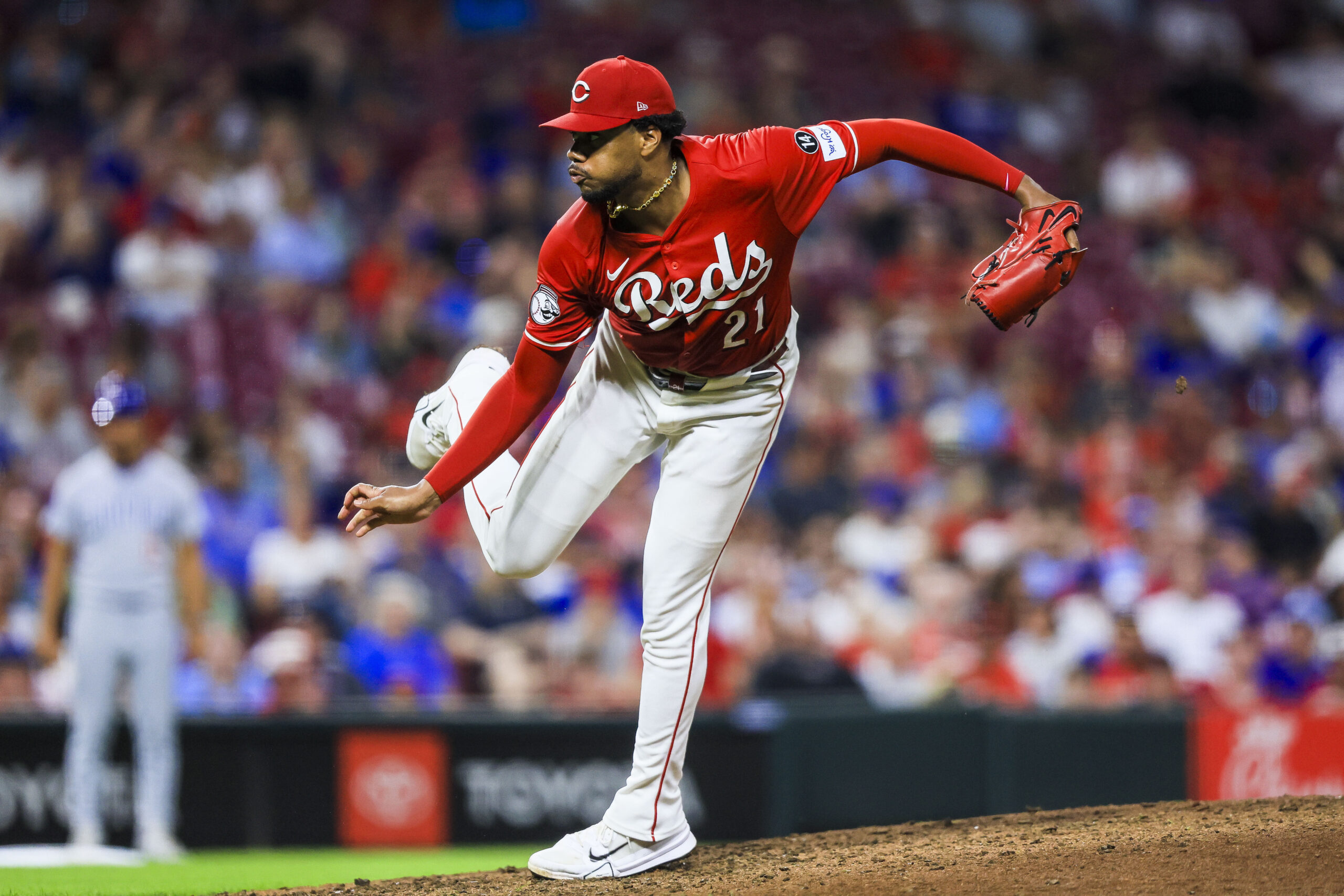
Hunter Greene’s 2025 season was once again shaped by injuries, as recurring right groin issues forced two separate injured list stints and limited him to just 107 2/3 innings during the regular season. He added three more innings in the Wild Card Round against the Los Angeles Dodgers, but overall volume remained the clear drawback.
When he was on the mound, however, Greene was exceptional. He finished with a 2.76 ERA, a career-best 0.94 WHIP and a 132-26 strikeout-to-walk ratio (K/BB) while dramatically cutting down on hit batters after leading MLB in that category the previous year. His per-inning production reinforced how dominant he can be for fantasy managers whenever he is healthy.
Hunter Greene’s Strengths, Weaknesses and 2026 Fantasy Baseball Projection
Greene’s strengths revolve around elite velocity and swing-and-miss capability. His four-seam fastball averaged 99.5 miles per hour, and he ranked in the 89th percentile or higher in chase rate, whiff rate and strikeout percentage.
That combination provides one of the highest strikeout ceilings among starting pitchers in fantasy baseball points leagues, where strikeouts carry substantial weight. He also showed improved command, which helped stabilize his WHIP and reduce unnecessary traffic on the bases.
The weaknesses remain tied to durability and home-run susceptibility. His home-run rate climbed back to 1.25 home runs per nine innings (HR/9) after significant progress the year prior, indicating that his 2024 suppression may prove to be the outlier.
Great American Ball Park continues to be a difficult environment for pitchers prone to fly balls, and Greene still leans heavily on a fastball-slider mix that can become predictable when location slips. He has surpassed 150 innings only once in his career, so workload sustainability remains the final hurdle in his development.
Looking ahead to 2026, Greene projects as a high-upside arm capable of near-ace production on a per-start basis, but with built-in volatility tied to health and innings limits. In points formats, his strikeout totals and strong ratios provide weekly impact, yet managers must account for the possibility of missed time and occasional home-run spikes.
A realistic projection places him in the mid-to-low 3.00 ERA range with elite strikeout numbers if he approaches a full complement of starts.
As far as pitcher hierarchy for fantasy baseball points leagues, I rank him at Tier 2 under Tarik Skubal, Garrett Crochet and Paul Skenes, among others, and higher than Bryan Woo, Jacob deGrom and Cole Ragans.
Leave a Reply