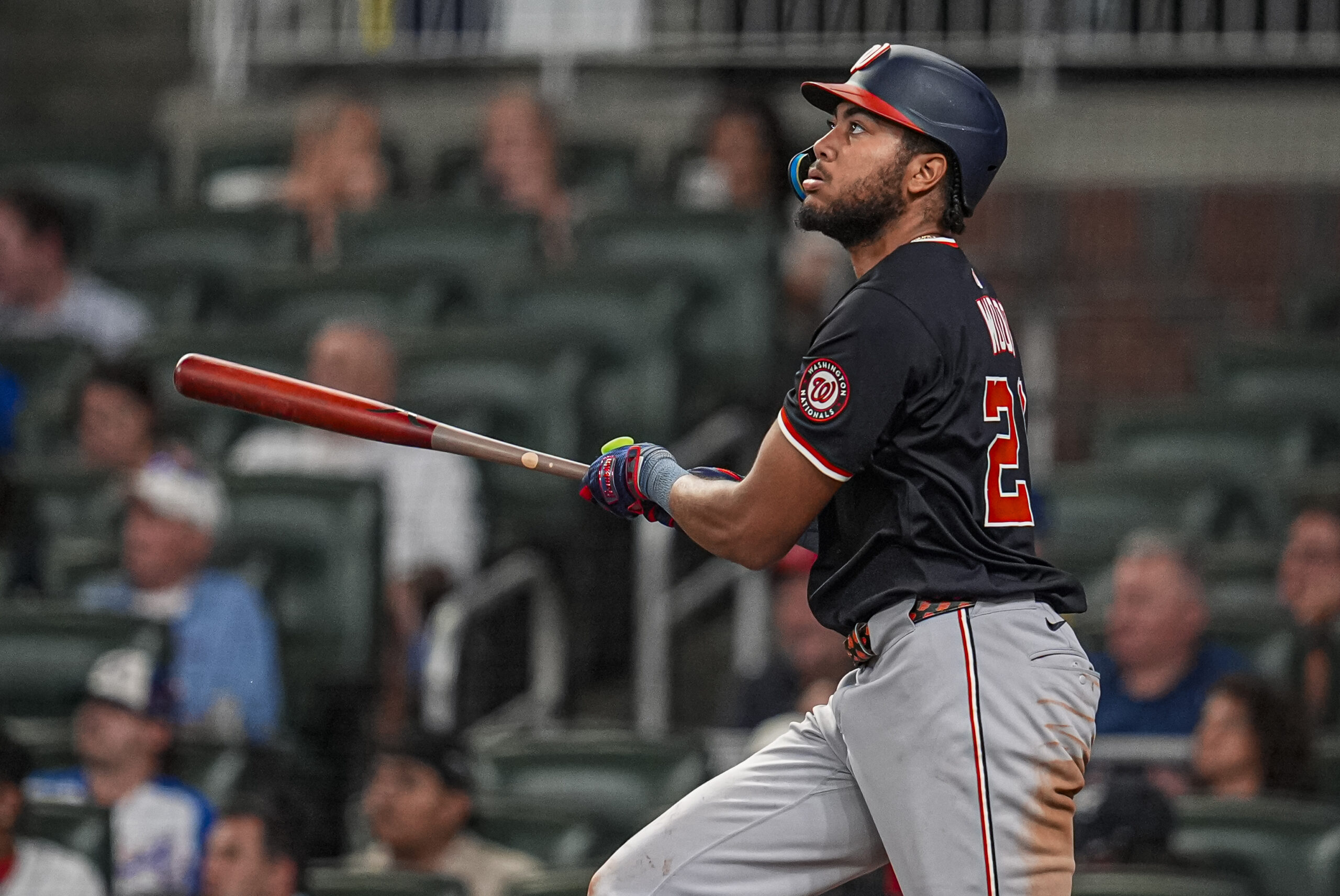
James Wood presents one of the more fascinating profile contrasts in today’s fantasy landscape. Unlike pull-heavy sluggers such as Jose Ramirez, Wood showed little interest in turning on flyballs, posting just an 11.3 Pull Air% last season, according to Statcast, compared to 30.9% for Ramirez.
Instead, Wood built his offensive identity by driving the baseball up the middle and to the opposite field, an approach that produced immediate results at the major-league level.
Wood’s power translated in a significant way, as he launched 31 home runs for the Nationals, with 26 of those blasts traveling either to center or the opposite field, according to Baseball Reference. That distribution highlights rare strength and barrel control for a hitter his age, reinforcing the idea that his raw power can play to all fields rather than relying on ideal pull-side conditions.
James Wood’s Strengths, Weaknesses, and 2026 Fantasy Baseball Projections
Wood also sits on the opposite end of the contact spectrum when compared to Ramirez. He struck out at a 32.1% clip last season, while Ramirez posted an 11% rate, underscoring the volatility embedded in Wood’s profile. It is not reasonable to measure a developing hitter against a future Hall of Famer, but the contrast illustrates the range of outcomes.
If Ramirez represents reliability, Wood currently projects as a high-variance asset capable of delivering both explosive stretches and difficult scoring droughts, a pattern that became visible when he slumped to a .223/.301/.388 line during the second half.
Despite the swing-and-miss concerns, the upside remains substantial. Few players at age 22 have already demonstrated the ability to impact the baseball with this level of authority while contributing across categories.
The added steals enhance his fantasy appeal, although efficiency remains an issue after he finished just 29-for-44 on the basepaths across his first two MLB seasons. Improvement in that area would raise both his real-life value and his weekly scoring consistency in points formats.
From a strengths perspective, Wood offers elite raw power, the ability to use the entire field, and a developing offensive approach that suggests further growth is possible as he gains experience. His weaknesses center on elevated strikeout totals, streakiness, and base-stealing inefficiency, all of which introduce risk into his projection. However, players with this combination of youth, power output, and physical tools rarely remain static.
Looking ahead to 2026, Wood, now 23 years old, projects as a potential middle-of-the-order force capable of clearing 30 home runs again while supplying double-digit steals if his opportunities hold.
Even moderate gains in contact rate could unlock another tier of production. Because fantasy baseball points leagues reward total bases and impact contact, his power foundation provides a scoring pathway that keeps his ceiling extremely attractive despite the volatility.
As far as the outfielder hierarchy for fantasy baseball points leagues, I rank him at Tier 3 under Aaron Judge, Juan Soto, and Ronald Acuña Jr., among others, and higher than Pete Crow-Armstrong, Wyatt Langford, and Roman Anthony.
Leave a Reply