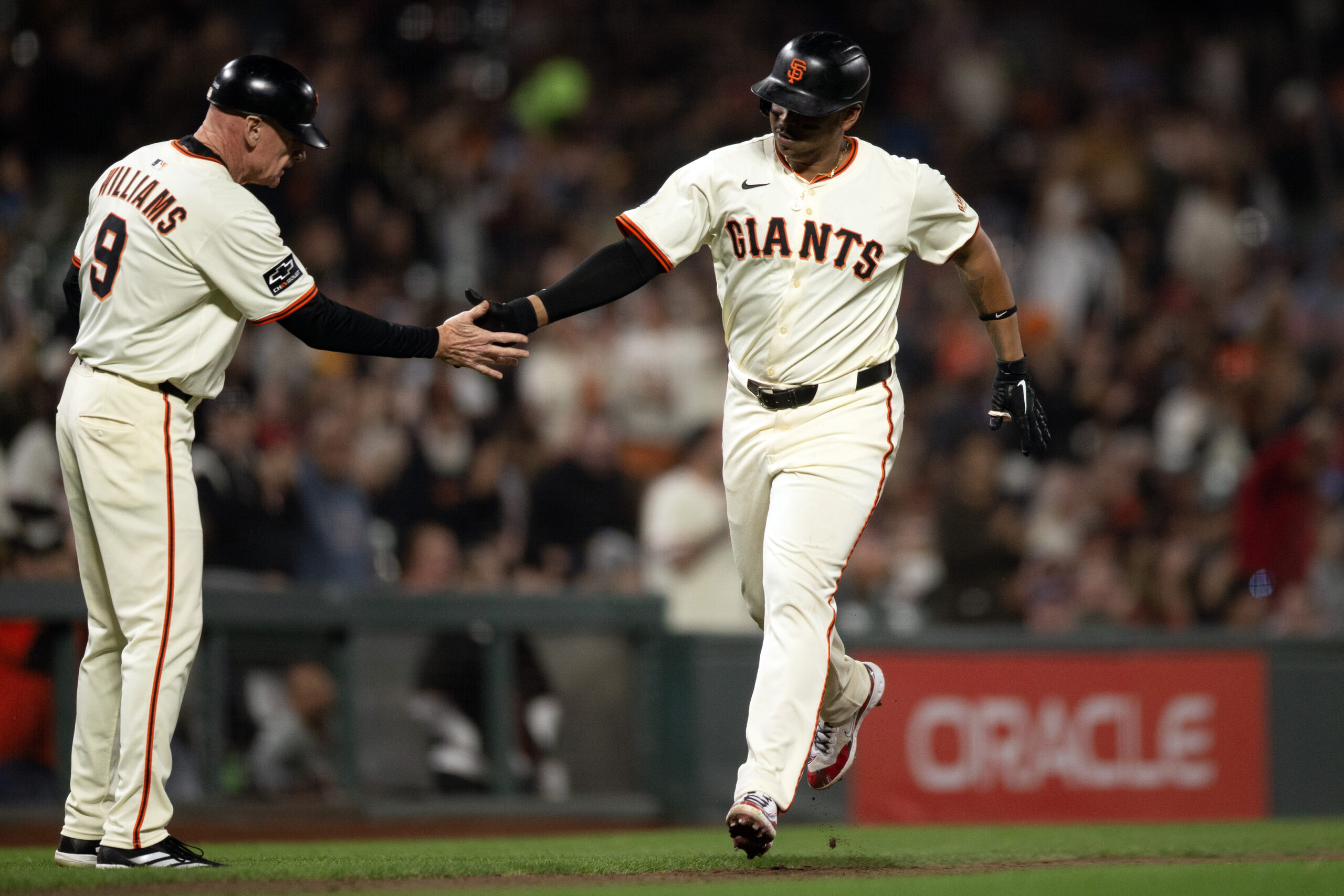
Rafael Devers experienced a turbulent 2025 campaign that featured both off-field friction and notable on-field production. During his first spring training media session, Devers stated he was unwilling to move to designated hitter to accommodate Alex Bregman’s arrival to the Boston Red Sox, insisting that third base remained his position.
Despite that stance, he ultimately opened the season as the designated hitter. Tensions resurfaced in May when the Red Sox asked him to cover first base following Triston Casas’ injury, a request Devers declined. Boston moved on shortly thereafter, trading him to San Francisco in mid-June in what functioned largely as a salary-clearing move.
Even with the transition, Devers remained productive. He launched 20 home runs in just 90 games after the trade, finishing with 35 for the season.
His overall production with the Giants dipped somewhat, however, as his strikeout rate (K%) climbed to nearly 30%. In an ironic twist, Devers eventually logged 28 starts at first base for San Francisco, giving him eligibility there entering 2026.
Now settled in pitcher-friendly Oracle Park, the three-time All-Star and two-time Silver Slugger should enter the upcoming season more comfortable with his role and surroundings.
Rafael Devers 2026 Fantasy Baseball Outlook: Strengths and Weaknesses
Devers’ primary fantasy appeal continues to stem from his middle-of-the-order power and run-production profile. His bat speed and natural lift allow him to generate home runs in bunches, and he remains capable of carrying an offense for extended stretches when locked in.
The added first-base eligibility enhances his versatility in points league formats, while his established track record suggests a relatively stable counting-stat floor despite the midseason team change.
The concerns revolve around contact quality consistency and the rising strikeout rate (K%) that approached 30% following the move to San Francisco. Oracle Park also introduces a slightly more challenging run environment than Boston, which could cap some of his top-end output. While Devers remains firmly in his prime, fantasy managers should recognize that his production may fluctuate more than the elite names above him in the tier structure.
From a fantasy baseball points league perspective, Devers still profiles as a strong middle-round cornerstone with clear 30-plus home run upside. A reasonable 2026 expectation includes continued impact power with solid run production, though modest batting average volatility should be anticipated.
As far as first-base hierarchy for fantasy baseball points leagues, I rank him at Tier 3 under Vladimir Guerrero Jr., Nick Kurtz, and Pete Alonso, among others, and higher than Josh Naylor, Ben Rice, and Vinnie Pasquantino.
Leave a Reply